Pursuant to the Royal Decree Establishing the Research and Innovation Acceleration Agency for Competitiveness and Area Development (Public Organization) B.E. 2568 (2025), a public organization shall be established, designated as the “Research and Innovation Acceleration Agency for Competitiveness and Area Development (Public Organization),” or abbreviated as “RCAD”
The organization shall comprise the following funding management units:
Program Management Unit for Competitiveness (PMUC)
Program Management Unit for Frontier Brainpower and Future Industries (PMUB)
Program Management Unit for Area Based Development (PMUA)
Program Management Unit for Arts, Knowledge, and Appropriate Technology Deployment (PMUD)
These units are mandated to unify research funding management, accelerate the practical application of research outcomes, and build national competitiveness. Consequently, the Program Management Units (PMUs) previously established under the Regulation of the National Higher Education, Science, Research and Innovation Policy Council regarding Program Management Units B.E. 2562 (2019) which were formerly legal entities under the Office of National Higher Education Science Research and Innovation Policy Council (NXPO), shall be transferred to be under RCAD, effective from January 1, 2026.
The head of the government agency shall be the “President of Research and Innovation Acceleration Agency for Competitiveness and Area Development.”
During the initial phase:
The Governing Board of the Office of National Higher Education Science Research and Innovation Policy Council (NXPO Council) shall perform the duties of the RCAD Board.
The Director of NXPO shall perform the duties of the President of RCAD until an official appointment is made.
The existing Boards and Directors of the Program Management Units shall continue to perform their respective duties until new Boards and Directors for the Program Management Units are appointed.
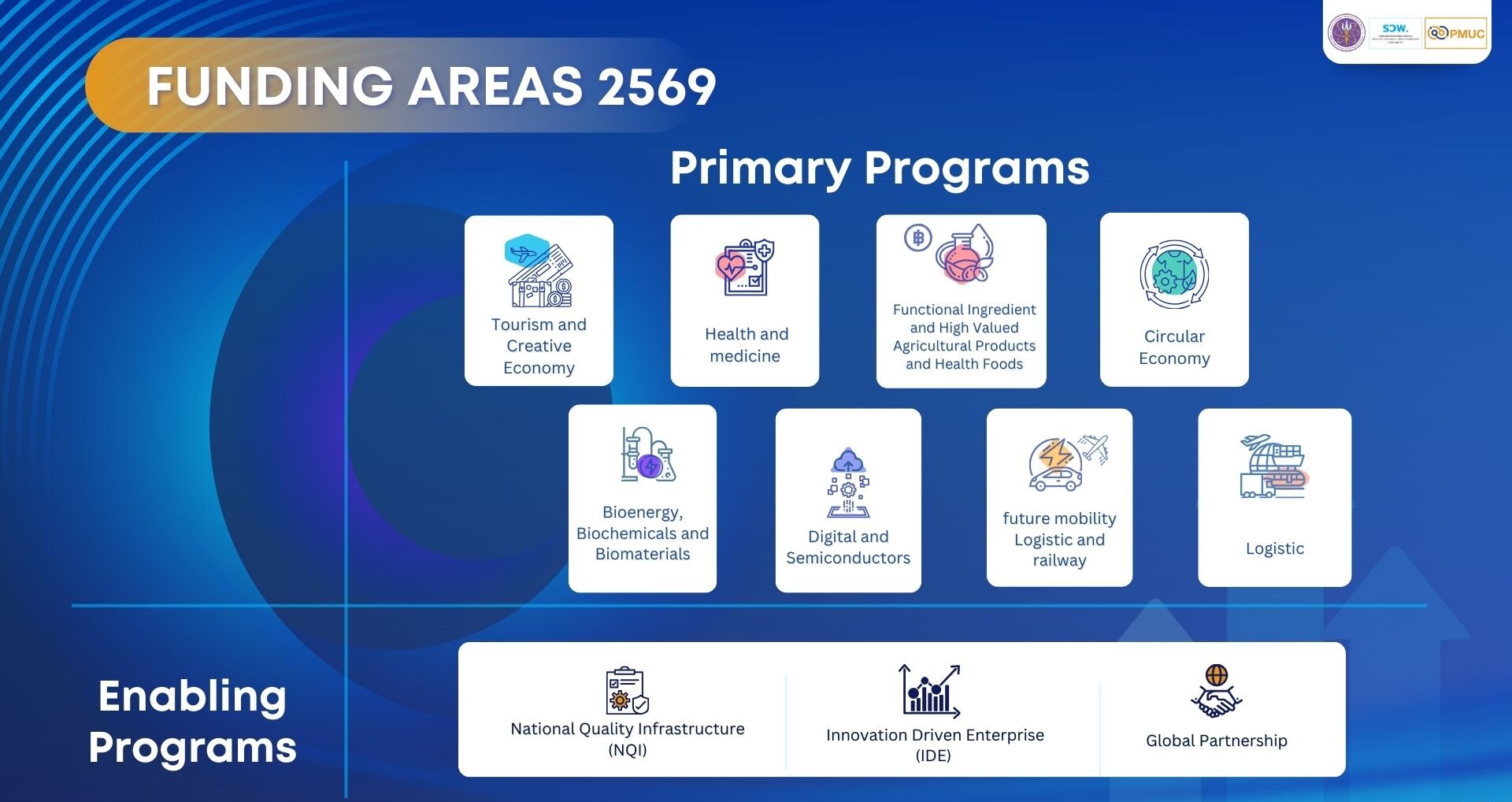
PMUC is a research funding unit that manages research and innovation fund aimed at enhancing the national competitiveness by creating innovations that enable industries to develop high-value goods and services to enter the global market, facilitating collaboration between the public and private sectors in Thailand and from abroad, and encouraging joint investment from firms, ranging from SMEs to large corporates. The seven industrial sectors of focus are:
Functional ingredient and High Valued Agricultural Products and Health Foods
Emphasis is given to the development of innovation and high-value food and agricultural products such as functional ingredients, flavorings, natural extracts, healthy food products, as well as cold chain systems and machineries for the agriculture and food industry.
Health and Medicine
Focus is placed on the development of drugs, biopharmaceuticals, advanced therapeutic medicinal products (ATMPs), medical devices, cosmeceuticals, laboratories, scientific infrastructures, as well as standard-compliant facilities for manufacturing and testing of medical products for product registration.
Bioenergy, Biochemical and Biomaterials
Attention is given to the development of renewable energy, biofuels, bioplastics and biochemicals.
BCG for Creative Tourism
Emphasis is put on the management of tourism and creative economy, including wellness tourism, cultural heritage and natural heritage to support sustainable tourism.
Digital Platform
Focus is put on the development and application of digital technology and artificial intelligence (AI) to strengthen Thailand’s digital economy and competitiveness.
Circular Economy of Thailand
Support is directed to the development of technologies, innovations, business models, platforms and ecosystem to support the circular economy transformation.
Future Mobility and Railway
Attention is given to the development of electric vehicle, railway, aviation, robotics and automation industries.
Logistic
Development of transport infrastructure, regulations, and e-logistics systems for ports, railways, roads, and airports.
In addition, PMU-C also promotes industrial competitiveness through the following five enabling programs:
Global Partnership
Collaboration with foreign partners is a mechanism that can be employed to enhance the national competitiveness. The Global Partnership Program fosters international collaboration that helps facilitate the diffusion of knowledge and technology in areas essential to the national social and economic development, enabling the creation of useful innovation benefiting the economy and society and making Thailand less dependent on foreign technology. Collaboration with foreign partners can also accelerate the innovation development in Thai firms and offer an opportunity to introduce Thai goods and services to international markets.
Innovation Driven Enterprises (IDEs)
As the source of innovation and employment, the industrial sector plays a vital role in freeing Thailand from the middle-income trap and leading Thailand to become a high-income nation. It is necessary to build technological capacity of Thai enterprises so that they can be upgraded to innovation driven enterprises (IDEs) to fuel the economy and enable Thailand to achieve its goal. The Innovation Driven Enterprises (IDEs) Program aims at developing technological capacity of SMEs by facilitate the development of an intermediary and innovative network to establish a robust innovation ecosystem for Thai SMEs to evolve into IDEs.
National Quality Infrastructure
The National Quality Infrastructure Program aims at strengthening Thailand’s national quality infrastructure system to support Thai industry to manufacture high-quality products and services that meet the requirements of international markets.